66 Hours a Month, ₪12,000 in Revenue: What Happened When a Dental Clinic Ditched Excel
A small dental clinic moved from Excel and sticky notes to an AI-powered CRM with GoHighLevel and Make. No-shows dropped 25% to 9%, 66 hours saved per month, ₪8-12K in monthly revenue recovered.
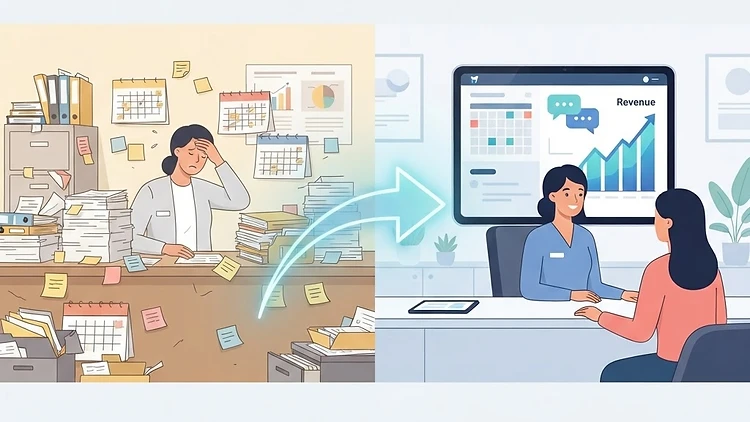
66 Hours a Month, ₪12,000 in Revenue: What Happened When a Dental Clinic Ditched Excel
Last updated: 27.09.2026
Dr. Ronit Levy was losing ₪12,000 a month — not because her dental clinic wasn't full, but because she was running it in Excel.
The clinic in Ra'anana — two chairs, two dental assistants, and Dr. Levy herself both treating and managing — is fully booked, the reputation is excellent, and referrals keep flowing. But behind the scenes, the picture is less rosy. 25% of appointments end in no-shows — customers don't arrive, don't cancel, and the chair sits empty. Every morning Dr. Levy opens the schedule and finds 3-4 gaps someone was supposed to fill. Each gap costs ₪400-800 in lost revenue — and per month that adds up to ₪8,000-12,000 (ILS) that simply disappears.
The management? One giant Excel spreadsheet, 1,200 customers, 15 columns, and folders full of sticky notes. Every day, 3.5 hours of the assistants' time goes to sending manual WhatsApp reminders, chasing customers who didn't respond, and trying to fill holes in the schedule. 3.5 hours — more than a third of an assistant's workday.
And Dr. Levy isn't alone. A 2026 Ryse study shows that 60% of the time businesses waste on Excel goes to "firefighting" — not strategic management. 48% of leads in small businesses never receive follow-up. And yet, most small clinics in Israel still operate this way — because it's what they know.
This is the story of how a small dental clinic moved from Excel and sticky notes to an AI-powered CRM — and turned 25% no-shows into 9%, 3.5 hours a day into 0.5, and ₪8-12K in monthly lost revenue into recovered income.
Before — What Running Everything in Excel Looks Like
Picture the day of Shira, the lead dental assistant. She arrives at 7:30, opens the Excel file, and gets to work:
Morning: sends reminders to 15 people with appointments tomorrow. Before that, marks in Excel who got a reminder and who didn't. A customer didn't respond? She sends again. And again. Between reminders, she answers the phone, seats customers for treatment, and calls whoever missed their appointment yesterday. Between 8:00 and 11:30 she sent 40 WhatsApp messages, answered 12 calls, and booked 5 new appointments.
Midday: who didn't show up today? Back to Excel, marking no-shows. Who's due for a routine checkup next month? She scans the "last treatment date" column and tries to remember to call at some point. A customer who came in 4 months ago and needs a cleaning? She won't remember. There are too many customers, and Excel doesn't alert anyone.
Evening: daily summary. How many no-shows were there today? Dr. Levy and Shira count manually. 3 no-shows today — seems normal. But that's ₪2,100 in revenue that walked away. And tomorrow? The same thing all over again.
This system feels normal because it's how it's always been. But the data says otherwise: dental clinics in Israel and worldwide report 15%-25% no-shows on average, and in extreme cases up to 48%. Studies show that automated reminders cut no-shows by 22.95% on average — but only when they arrive at the right time, on the right channel, with follow-up.
The Solution — What Was Built and How It Works
The migration took 3 weeks, at a monthly cost of ₪370 (GoHighLevel) plus ₪35-115 (Make), with zero lines of code. Here's what was built:
Process 1 — Automated Reminders (24 Hours Before the Appointment)
The customer gets an automatic WhatsApp message 24 hours before the appointment: "Hi [name], a reminder that you have an appointment tomorrow at 2:00 PM with Dr. Levy. To confirm — reply 'yes'. To cancel — reply 'cancel'."
If the customer replies "cancel" — the system instantly releases the slot, messages customers on the waiting list, and updates the calendar. If the customer doesn't respond — a second reminder goes out 3 hours before the appointment. If there's still no response — the assistant gets an alert and calls manually. Only those who truly need a phone call.
The result: 85% of customers confirm or cancel via message. Only 15% require a manual call — and even then, the assistant knows exactly who to call and why. In Israel, with 90% WhatsApp penetration, this is the natural channel — customers expect business messages on WhatsApp, not phone calls.
Process 2 — Automated Lead Follow-Up
A new customer reaches out through the clinic's website or WhatsApp? The system immediately sends a welcome message, offers available slots, and if there's no response within 24 hours — sends a follow-up. After 48 hours — a third message offering a consultation call. The entire process is logged in the CRM, so Shira can see exactly what happened with each inquiry and where the customer stands in the funnel.
Before the system: a new inquiry went into Excel, and if Shira didn't manage to respond within two days — the customer had already contacted another clinic. No surprise: 48% of leads in small businesses never get follow-up. Now: every new inquiry gets a response within minutes, and automated follow-up makes sure no lead falls through. Lead loss dropped from 48% to under 10%.
Process 3 — Automated Rebooking (3 Months After Treatment)
Three months after a routine treatment (cleaning, checkup), the system sends an automatic message: "Hi [name], it's been 3 months since your last treatment. Time for a routine checkup. To book — reply 'appointment' and we'll send you available slots."
The customer replies "appointment"? The system offers 3 slots, they pick one, and the appointment lands in the calendar. All automatic. Shira doesn't need to remember, search the Excel file, or call anyone.
Before the system: an internal survey Dr. Levy ran showed that 40% of customers don't return for routine checkups on time — not because they don't want to, but because nobody reminded them. Now: the system reminds them, and the return rate rose from 60% to 82% — a 37% increase.
The Results — 90 Days Later
After three months on the new system, the numbers speak for themselves:
| Metric | Before | After | Change |
|---|---|---|---|
| No-show rate | 25% | 9% | 64% decrease |
| Daily time on reminders | 3.5 hours | 0.5 hours | 86% decrease |
| Hours saved per month | — | 66 hours | — |
| Revenue recovered from no-shows | ₪0 | ₪8,000-12,000/month | — |
| Routine checkup return rate | 60% | 82% | 37% increase |
| Monthly referrals | 2 | 8 | 300% increase |
| Response time to a new lead | Hours | Minutes | — |
| Monthly system cost | ₪0 | ₪405-485 + VAT | — |
The most significant number: ₪8,000-12,000 in monthly revenue recovered from eliminated no-shows. That means the system pays for itself in the very first month — ₪370 for GoHighLevel plus ₪35-115 for Make, a total of ₪405-485 + 18% VAT per month, versus ₪8,000+ recovered. The ROI is 1:16 in the low-case scenario.
What does Shira do with the 3 saved hours? She answers the calls that genuinely need her, handles communication with insurance companies, and greets customers at the entrance instead of being glued to the screen. Dr. Levy herself no longer has to intervene in schedule management — she knows the chairs will be full.
Market Data — Why This Story Isn't Unique
The Ra'anana dental clinic case reflects a much broader phenomenon. Here's the data:
- 60% of business time on Excel goes to "firefighting" — reminders, follow-up, fixing errors — instead of strategic management (Ryse, 2026).
- 48% of leads in small businesses never receive follow-up. That means nearly half the inquiries coming in simply vanish.
- Businesses with a CRM saw 47% higher revenue growth than businesses without one (Nucleus Research).
- 20% increase in sales within six months — the average businesses report after moving to a CRM with automation (Salesforce/LinkedIn Insights).
- 90% WhatsApp penetration in Israel — this is the channel your customers are already on. If you're not there, you're missing out.
Government Grant — The State Funds 35%
And now for a point most businesses don't know: the State of Israel grants up to ₪350,000 for AI adoption and digitization in businesses, with the state funding 35% of the cost (gov.il, July 2026). That means a migration costing ₪5,000-15,000 can receive significant state participation. Dental clinics, beauty salons, and other clinics — all businesses that fit the program. Worth checking the current program on the Ministry of Economy website before budgeting.
Content Competition — Why There's No Case Study Like This in Hebrew
We checked 8 Israeli sources (Vitrue, SolutionsCRM, Expert.co.il, ScallaCRM, Salesforce IL, Israel Hayom, Ryse, LynxBe). All of them publish generic guides ("how to choose a CRM") or marketing content promoting a specific product. None — not one — tells a case study with real before/after data of an Excel-to-CRM migration. That's our gap, and it's exactly what this article fills.
Lessons — What Worked, What Didn't, and What We'd Do Differently
What worked immediately:
- Automated WhatsApp reminders — customers responded instantly. Most are already used to confirmation messages from businesses, so the transition felt natural.
- Filling gaps — when a customer cancelled, the system reached out to the waiting list and filled the slot within minutes. This alone recovered revenue immediately.
- Logging — every call, every inquiry, every appointment — it's all documented. Dr. Levy can open a customer card and see the entire history.
What took time:
- Automated rebooking — in the first month, some customers felt the message was robotic. Dr. Levy added a personal touch ("Dr. Levy reminds you...") and the tone changed. Rule of thumb: automated messages need to sound human.
- Managing the waiting list — at first the system messaged the entire list at once, and 3 customers booked the same slot. Fix: adding a process that marks a slot as "being scheduled" and prevents duplicates.
What we'd do differently:
- We would start with just one process (reminders) instead of three at once. The migration would be less stressful and adoption faster.
- We would invest a week in writing message templates — not settling for the first draft that looks reasonable, but testing with customers. Message tone is critical.
- We would check the government grant before implementation — a potential ₪350,000 can significantly reduce the cost.
Summary — and What It Means for Other Businesses
The story of the Ra'anana dental clinic isn't unique. Every small clinic managing customers in Excel, sticky notes, and manual messages — faces the same problems. No-shows that vanish, customers who forget to come back, and assistants swallowing hours of work a computer can do in 30 seconds.
The migration doesn't require a hi-tech budget. GoHighLevel ($97/month, ₪370+ VAT) provides a CRM, business WhatsApp, and automated messaging in one system. Make connects everything together — calendar, reminders, lead follow-up — without code, with visual drag-and-drop. The monthly investment: ₪405-485 + VAT. The return: ₪8,000+ in recovered revenue. It's not a cost — it's an investment that pays for itself in the first month.
Want to make the same move in your business? Start with one process — automated reminders — and expand from there. And before you budget — check the government grant program. The state funds 35%.
Try Make for free — free plan with 1,000 credits per month, no credit card required
GoHighLevel — CRM + WhatsApp + automation in one system
Also read: Excel to CRM Conversion Guide — the complete guide to migrating customer management from Excel, with a step-by-step process, mistakes to avoid, and tool recommendations.
Disclosure: The Make and GoHighLevel links in this article are affiliate links. We'll receive a commission if you purchase a subscription through them, at no extra cost to you. The recommendations are based on hands-on experience and fit for small businesses in Israel.
Want to stay updated on automation, AI, and small business management? Subscribe to the UDigitalAI newsletter — and get the tools and processes that actually save time and grow revenue delivered straight to your inbox.
As of August 2026. Prices and features may change — check with the vendors before purchasing.
Recommended SaaS tools for your business
Tools we've tested in the field with clients and businesses — worth the investment. Links marked as affiliates: if you buy through them we earn a commission, at no extra cost to you.
Zapier
אוטומציהחבר יותר מ-6,000 אפליקציות ובנה אוטומציות ללא קוד — מהמהירות ביותר להפעלה בעסק.
Make
אוטומציהאוטומציה ויזואלית עם בקרה מדויקת על כל שלב — מתאים לזרימות עבודה מורכבות.
Notion
פרודוקטיביותמסמכים, מסדי נתונים וניהול פרויקטים במקום אחד — בסיס ידע מרכזי לצוות.
HubSpot CRM
CRMניהול לקוחות חינמי עם כלים שיווקיים מובנים — נקודת התחלה מצוינת לעסקים צומחים.
ChatGPT Plus
AIגישה ל-GPT-4o וכלי יצירה מתקדמים — עוזר אישי AI לכתיבה, ניתוח ומחקר.
Airtable
ניהול נתוניםמסד נתונים גמיש שמרגיש כמו גיליון — לניהול תהליכים עסקיים בלי פיתוח.
Disclosure: some links on this page are affiliate links. If you purchase through them, UDigitalAI may earn a commission — our recommendations are based on hands-on experience, not on the commission.
Comments
Share your insights and join the conversation.
No comments yet. Be the first to respond.
ID: UDA-EN-015